Blog
The U.S. Department of Housing and Urban Development (HUD) has not yet approved the 2021 or 2024 IBC and A117.1-2017 as FHA safe harbors. If your jurisdiction has adopted these codes, you must select a separate FHA safe harbor or risk noncompliance.

The Fair Housing Act (FHA) is a federal civil rights law that applies to all buildings of four or more connected dwelling units built for first occupancy after March 13, 1991. All projects subject to the FHA must ensure compliance with the seven design and construction requirements of the Act:
To ensure compliance with these requirements, it is important to select and comply fully with one of the safe harbors approved by the U.S. Department of Housing and Urban Development (HUD).
Unless a HUD-approved safe harbor is selected and complied with in its entirety, then the onus is on the architect (and the owner) to demonstrate how FHA equivalency is achieved. HUD clarified this in a prior safe harbor rule published in the Federal Register on July 18, 2007, stating that “…the owner, developer and designer must comply with the safe harbor in its entirety without modification or waiver.” From HUD’s perspective, “if it is shown that the designer and builder departed from the provisions of a safe harbor document, they bear the burden of demonstrating that the dwelling units nonetheless comply with the Act’s design and construction requirements.”
Demonstrating compliance with the FHA without the protection of having fully complied with a safe harbor typically takes place during litigation and is a lengthy and costly process.
Up through 2020, there were 10 HUD-approved safe harbors. Effective March 8, 2021, five additional safe harbors were added, including the 2009 edition of the International Code Council Accessible and Usable Buildings and Facilities A117.1 Standard (A117.1-2009) and the 2009, 2012, 2015, and 2018 editions of the International Building Code (IBC). This was a big step in aligning building code and FHA requirements, allowing designers in jurisdictions that adopt Chapter 11: Accessibility of the IBC to design to one set of requirements.
However, as the IBC continues to be updated, the building code has once again outpaced the approval of FHA safe harbors. Jurisdictions across the country have begun adopting the 2021 and 2024 IBC editions, which reference A117.1-2017. Neither of the newest IBC editions nor A117.1-2017 have been approved by HUD as safe harbors for FHA compliance.
Per the Federal Register dated March 8, 2021, HUD has provided an expedited process for review and approval of new safe harbors: “HUD may propose safe harbors by Federal Register notification that provides for a minimum of 30 days public comment period. HUD will publish a final notification announcing safe harbors after considering public comments. Compliance with safe harbors established by Federal Register notification will satisfy the requirements…”
HUD has not yet proposed the new IBC editions or A117.1-2017 as safe harbors.
This means, for projects in jurisdictions that have adopted the 2021 or 2024 IBC, designers can no longer rely on full compliance with the building code to demonstrate compliance with the FHA. Until HUD establishes the newest IBC editions and A117.1-2017 as safe harbors, it is important that designers select and comply with an approved safe harbor in its entirety. If the requirements of one of the approved safe harbors are not incorporated into the design and the project complies only with the accessibility requirements of the building code, the risk of noncompliance exists.
The 2017 edition of the A117.1 standard contains significant changes from the 2009 edition. While many of the modified requirements provide an equal or greater level of accessibility when compared to the A117.1-2009 edition, there are some elements throughout that do not align with requirements in any of the HUD-approved safe harbors. Here are a couple of examples:
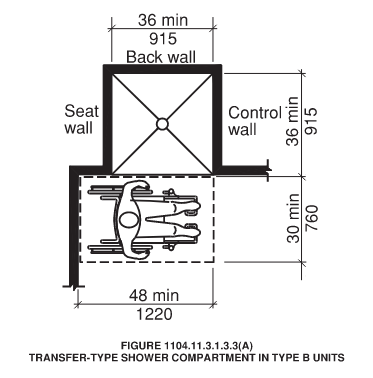
Per Type B unit bathroom criteria, where the shower is the only bathing fixture in the dwelling unit, the shower must provide clear interior dimensions of at least 36 inches in depth and 36 inches in width. This requirement is consistent across all HUD-approved safe harbors.

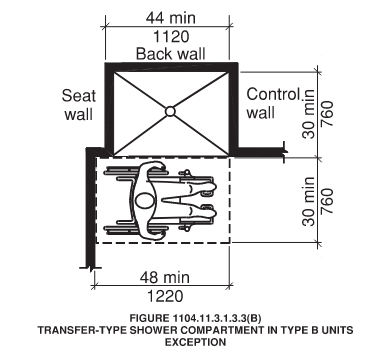
However, A117.1-2017 Section 1104.11.3.1.3.3 adds an exception to this requirement: “A shower compartment with dimensions of 30 inches minimum in depth and 44 inches minimum in width shall be permitted.”

If designers follow this exception, they open themselves up to potential liability as the shower dimensions permitted in this exception are not permitted by any of the HUD-approved safe harbors for FHA compliance. Providing a 30×44 inch shower as the only bathing fixture in an FHA-covered dwelling unit will mean noncompliance with Requirement 7: Usable Kitchens and Bathrooms.
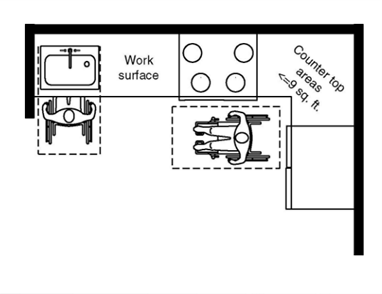
Accessible outlets are required in dwelling unit kitchens. Depending on the safe harbor, different scoping provisions apply. A117.1-2017 contains a new exception to operable parts criteria that exempts receptacle outlets between appliances in the corner of L- or U-shaped kitchens based on countertop area.
A117.1-2017 Section 1004.9, Exception 3 states that …”where a clear floor space for a parallel approach cannot be located at a countertop in a corner between appliances, receptacle outlets over the countertop shall not be required to comply with this section provided that the countertop area does not exceed 9 square feet maximum.”

If designers follow this exception in kitchens with limited countertop receptacles, this could result in insufficient accessible outlets to satisfy the requirements of any of the HUD-approved safe harbors for FHA compliance. This is especially important to consider in small kitchens with islands or peninsulas where electrical code may not require outlets to be installed. Failure to apply requirements for kitchen outlets from one of the HUD-approved safe harbors can mean noncompliance with Requirement 5: Light Switches, Thermostats, and Other Environmental Controls in Accessible Locations.
When working on a project that is subject to a building code that is not a HUD-approved safe harbor for FHA compliance, always select a safe harbor and apply it to the entire project. Be sure to overlay the requirements of the code and the safe harbor and follow the most stringent criteria.
Questions about which safe harbor you should use for your project? Contact us! Our consultants are happy to help.
Author: Theresa D’Andrea, Accessibility Director at SWA
Steven Winter Associates